Pull up Homes.com for Blue Ridge and you'll find a median sale price of $610,000, down 10 percent from a year earlier. Scroll to a different page on the same site, filtered to houses instead of the general overview, and the median jumps to $1,617,500, down 16 percent. Check the site's own "recently sold" page and you'll land on a third number: $1,550,000, down 20 percent. Redfin, looking at the same stretch of Seattle in July 2026, reports an average price of $2.7 million, up 56.2 percent year over year. Zillow's estimate lands closer to $1.4 million, but that figure covers a different footprint entirely.
None of these sites are wrong, exactly. They're all measuring something slightly different, and in a neighborhood this small, that difference is the whole story. If you're comparing Blue Ridge to other Northwest Seattle enclaves and trying to figure out what your money actually buys, the headline median is close to useless on its own. What matters is understanding why the number moves so much, and what it's not accounting for at all.
A Market Too Small to Average
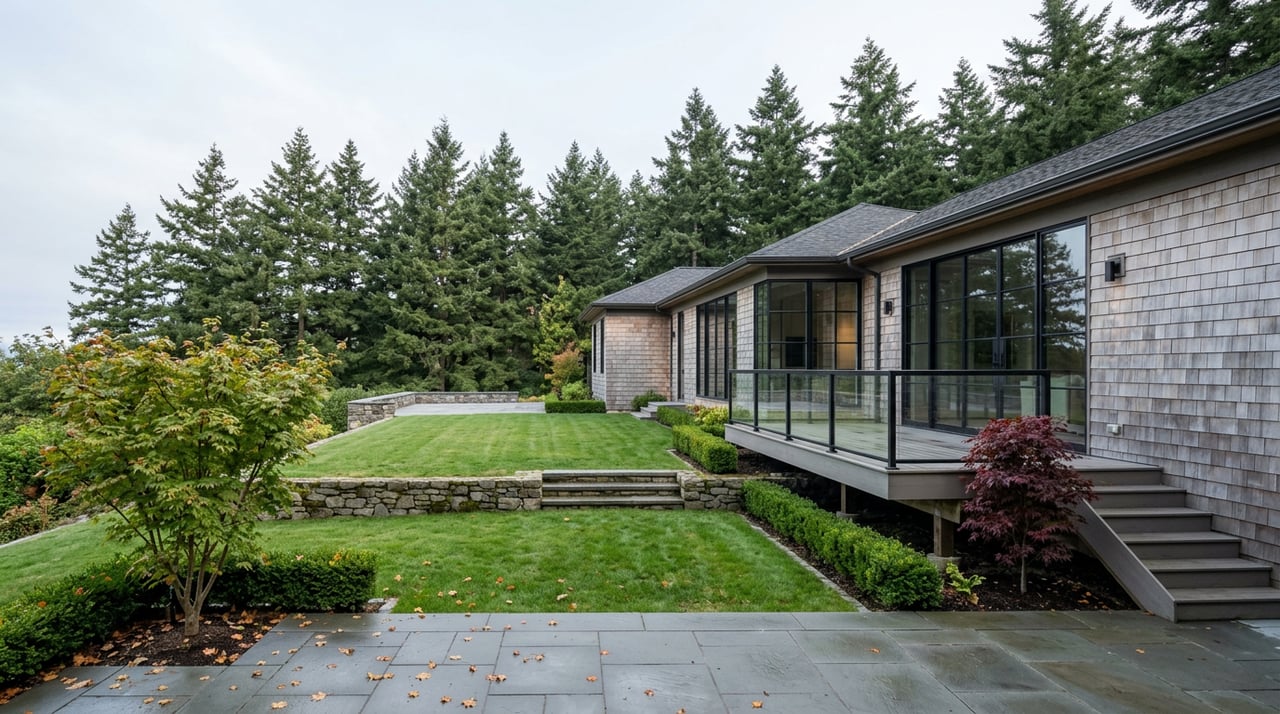
Blue Ridge is a roughly 450-home enclave tucked into the bluffs above Puget Sound. It doesn't turn over often, and when it does, the sample size is tiny enough that a single sale can swing a median by hundreds of thousands of dollars. Homes.com's own listing pages showed just three active homes for sale at the time of research. With that little inventory, a $1.6 million sale and a $2.8 million sale in the same quarter aren't two data points among many. They're most of the dataset.
The picture gets murkier because not every site is measuring Blue Ridge on its own. Zillow's estimate and Movoto's reported median both cover a combined area called "North Beach-Blue Ridge," which folds in an adjacent, somewhat less expensive community south of Blue Ridge proper. That's a reasonable way to build a bigger sample, but it means the number you're seeing isn't a price for Blue Ridge. It's a blended price for two neighborhoods with different housing stock, different amenities, and, as it turns out, a meaningfully different price floor.
Here's how the same market looked across sources pulled in the summer of 2026:
| Source | Reported figure | Window |
|---|---|---|
| Homes.com, neighborhood overview | Median sale price $610,000 (down 10% YoY) | trailing 12 months, pulled Aug 2026 |
| Homes.com, houses-for-sale page | Median sale price $1,617,500 (down 16% YoY) | trailing 12 months, pulled Aug 2026 |
| Homes.com, recently sold page | Median sale price $1,550,000 (down 20% YoY) | trailing 12 months, pulled Aug 2026 |
| Redfin | Average price $2.7 million (up 56.2% YoY) | July 2026 |
| Zillow (North Beach-Blue Ridge combined) | Average home value $1,436,713 (down 1.2% YoY) | as of 7/31/2026 |
| Movoto (North Beach-Blue Ridge combined) | Median list price $1.22 million, $429/sq ft | August 2026 |
Look at the spread. The same corner of Seattle, in roughly the same window, produces numbers that range from $610,000 to $2.7 million depending on which page you land on. That's not market volatility. That's what happens when a handful of transactions gets run through different math on different boundaries.
One Sale Changes Everything
Blue Ridge was platted in 1930 as one of the first subdivisions developed on land William Boeing had purchased in northwest Seattle. Five of the original homes built for Boeing executives are still standing, and residents refer to them as "the castles." They're not a separate housing category on any MLS sheet, but they illustrate exactly why a thin market misbehaves statistically. If one of those homes changes hands in a given year, it pulls the average up by a margin that would be a rounding error in a neighborhood with thousands of annual sales. In Blue Ridge, it's the whole trend line.
That thinness doesn't mean the market is soft. Redfin's Compete Score for Blue Ridge sat at 83 out of 100 as of the same July 2026 window, and homes were selling in about 8.5 days on average, with many receiving multiple offers and some buyers waiving contingencies. So you have a market that is simultaneously fast, competitive, and nearly impossible to average cleanly. Both things are true at once, and a buyer who only reads the headline median will misunderstand which one matters more for their own offer strategy.
The Line Item No Portal Shows You
Every number above describes what you pay to purchase the house. None of them describe what you're actually buying into.
Blue Ridge homes carry membership in the Blue Ridge Club, and that membership isn't optional or add-on. Under the community's covenants, it runs with the property. Buy a home here and you inherit access to a private pool, tennis and pickleball courts, a clubhouse, gated saltwater beach access, and neighborhood parks including Woodbine Park. You also inherit the dues that fund them, and those dues are a separate, recurring cost sitting outside the mortgage payment, the property tax bill, and every median price quoted above.
The exact current due amount isn't published on any of the portals pricing the neighborhood, which is itself worth noting. The Blue Ridge Club's own site maintains a dedicated prospective buyer and escrow information process, which tells you this is handled the way a formal HOA resale disclosure should be handled: requested directly, verified during due diligence, and confirmed before closing rather than assumed from a listing description. If you're comparing the true cost of owning in Blue Ridge against a neighborhood without a mandatory club structure, that dues line is not a footnote. It's part of the actual price of the house, and it's the one number that never shows up next to the median.
Comparing Blue Ridge to Its Neighbors
If you're weighing Blue Ridge against other Northwest Seattle options, three habits will serve you better than trusting any single median.
First, ask for the actual comparable sales from the last few months rather than a rolling twelve-month average. In a market this thin, three recent sales tell you more than a blended annual figure that might be smoothing over one unusually high or low outlier.
Second, confirm whether the number you're looking at describes Blue Ridge alone or the combined North Beach-Blue Ridge reporting area. The two communities sit next to each other and share a general character, but they're not priced identically, and a figure built from both will understate what a Blue Ridge address specifically commands.
Third, request the HOA resale certificate and current dues schedule early in your search, not after you've written an offer. Because membership is deed-attached rather than optional, it changes your monthly carrying cost in a way that a generic mortgage calculator won't capture.
Frequently Asked Questions
Is Blue Ridge Club membership optional? No. Membership follows the property under the community's covenants, conditions, and restrictions, so it transfers automatically with ownership rather than functioning as an opt-in extra.
Why do some sites report Blue Ridge and North Beach as one market? A few portals track a combined "North Beach-Blue Ridge" boundary that includes both communities together. That's a reasonable way to build a larger sample size for statistical purposes, but it blends two neighborhoods with different housing stock and amenities into a single number, which softens the picture of what Blue Ridge itself commands.
Where do I find the current club dues before making an offer? Through the Blue Ridge Club's own prospective buyer and escrow information process, requested during your transaction's due diligence period. It won't appear on a listing page, and it shouldn't be assumed from an outdated or third-party estimate.
If you're trying to make sense of what a specific number means for your own search, or you want a second opinion on a listing you're already circling, Strong Properties is a good place to start that conversation. Work with Portia, and get a read on the market that goes past whichever page happened to load first.