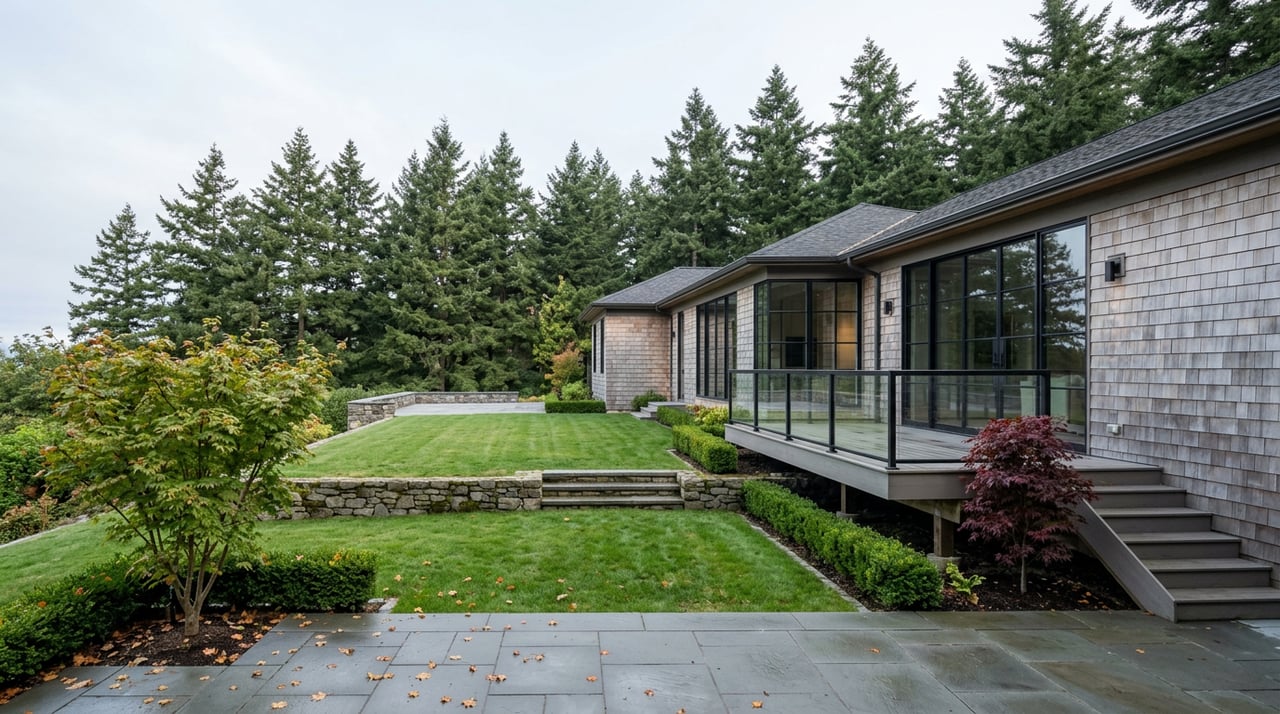
In Windermere's first-quarter 2026 report on Seattle-area waterfront sales, one line stood out from the rest of the data. Nearly every private-waterfront home across the region sold at or below its asking price that quarter. One did not. A mid-century home on 75 feet of Magnolia waterfront closed more than $300,000 over its original list price, the kind of gap that doesn't show up when a home is merely well-marketed. It shows up when the supply of something is close to zero.
That's the story underneath every median price you'll see quoted for Magnolia this year. The number on a portal, the number in a brokerage newsletter, the number a lender's automated valuation spits out: none of them are describing one market. They're averaging two markets that behave nothing alike, and the gap between them is exactly why a buyer comparing "Magnolia" to "Ballard" or "Queen Anne" on price alone is comparing the wrong thing.
A Peninsula With a Hard Ceiling on View Supply
Magnolia sits on a headland with water on three sides, and the geography isn't incidental to the market, it produces it. Only three roads get a car off the peninsula: West Emerson Street to the north, West Dravus Street through the center, and West Garfield Street, better known as the Magnolia Bridge, to the south. No passenger rail stops here. That isolation has kept Magnolia's housing stock unusually stable in character, but the more important effect is topographic. The land rises from Magnolia Boulevard toward the bluff, and every lot along that rise is competing for the same slice of Puget Sound, the Olympics, or the downtown skyline. Perkins Lane, tucked below the bluff and only yards from the water, and Viewmont Avenue, higher up, are the two streets locals point to first when the conversation turns to Magnolia's most expensive real estate. That's not branding. It's the physical fact that unobstructed water and mountain views are finite on a peninsula this size, and a home either has one or it doesn't.
That scarcity is what turned one mid-century waterfront property into a $300,000-over-ask outlier in a quarter when almost nothing else moved that way. It's also why appraisers don't treat a view as a flat percentage bump the way some pricing tools imply. Lending-appraisal guidance asks an appraiser to rate a view on its own line: full, partial, or seasonal, and beneficial, neutral, or adverse, then support that rating with comparable sales that share the same characteristic. County assessment practice does something similar, treating topography and outlook as primary influences on land value rather than an add-on to square footage. In other words, the professionals who set value for lending and tax purposes have already concluded what the sales data shows: a bluff-top or waterfront home isn't a nicer version of an interior home. It's competing in a different pool of buyers entirely.
What the Sub-Neighborhoods Actually Show
Magnolia isn't administratively one neighborhood either. The city's own neighborhood map divides the peninsula into Lawton Park to the north, Briarcliff along the southwest quarter near Discovery Park, and Southeast Magnolia along the southeast, with smaller enclaves like Carleton Park and Lawtonwood layered inside those boundaries. Briarcliff has carried a premium for a long time, a 2015 Redfin survey once placed it among the five highest median-priced neighborhoods in the city, and that reputation still shapes how Briarcliff listings get priced against the rest of the peninsula today.
Southeast Magnolia is the clearer recent example of what happens when the interior-street side of the market cools while the view tier doesn't. Over the three months ending April 2026, Redfin reported Southeast Magnolia's median sale price at $1.3 million, down 19.9% from the same period the year before, with homes taking 13 days to sell on average instead of 8. Twenty-six homes sold that April, up from 16 the year prior, which tells you inventory loosened up even as the price per sale came down. That's a market absorbing more supply at a softer price, the textbook signature of an interior-street segment normalizing after a hotter stretch.
Meanwhile, NWMLS-sourced listing data from July 2026 placed interior single-family asking prices across the broader Magnolia peninsula in the $1 million to $1.8 million range, while homes on the bluff or with a genuine water view were asking $2 million to more than $5 million, a gap wide enough that the two groups barely overlap. The same data window put the median sale price across the entire Magnolia zip code at $953,000, a number that blends condos, townhomes, and single-family homes of every type across the peninsula. That figure isn't wrong. It's just not a number a single-family buyer or seller should anchor to, because it's diluted by property types that aren't competing for the same buyers as a view lot on Magnolia Boulevard.
| Segment | Window | Median or asking price | Days on market |
|---|---|---|---|
| Southeast Magnolia (interior) | 3 months ending April 2026 | $1.3M, down 19.9% YoY | 13 days, up from 8 |
| Magnolia zip code, all property types | As of July 2026 | $953K | Not broken out |
| Interior single-family (peninsula-wide) | As of July 2026 | $1M–$1.8M asking | Roughly 9 days peninsula-wide |
| Bluff or water-view single-family | As of July 2026 | $2M–$5M+ asking | Roughly 9 days peninsula-wide |
Read across that table and the disagreement between data sources stops looking like an error and starts looking like arithmetic. Zillow's home-value index and Redfin's median sale price track different things, one estimates typical value across a rolling window of homes, the other reports what actually closed that month, and both get pulled in different directions depending on how many bluff-tier sales happen to land in that window. A single month with two Perkins Lane closings will move a neighborhood-wide median far more than a dozen ordinary interior sales will.
What This Means If You're Pricing a Listing
If you're preparing to sell a Magnolia home, the practical takeaway isn't "get a view home to sell for more." It's that your comparable set has to match your lot type, not your zip code. A home on an interior street competing against the zip-code median of $953,000 is being measured against a number that includes condos and townhomes it will never actually compete with at showing. A home with a genuine, durable water or mountain view has almost no honest comparables inside Magnolia at all, which is why those listings often benefit from a slower, more deliberate launch built around the specific view and the handful of recent sales that share it, rather than a fast-market pricing strategy built for the interior-street segment.
The Windermere waterfront outlier is the clearest illustration of why overreaching on a modest or partially obstructed view backfires. The $300,000 premium wasn't a marketing win, it was a scarcity premium on 75 feet of genuine waterfront, the kind of asset that has no substitute a buyer can drive to instead. A partial view of a neighbor's roofline is not that asset, and pricing it as though it were tends to show up as extra days on market rather than extra dollars at closing.
What This Means If You're Buying
For a buyer comparing Magnolia to Queen Anne, Ballard, or another northwest Seattle option, the useful question isn't "what's Magnolia's median price." It's "which Magnolia am I actually shopping." An interior lot in Lawton Park or Southeast Magnolia buys into the peninsula's walkability, its parks, and its proximity to Magnolia Village without competing for bluff pricing. A Briarcliff or Magnolia Boulevard address buys into a market where the comparable sales are thin and the seller has real leverage if the view is legitimate. Both are Magnolia. Neither is priced like the zip-code median suggests.
Frequently Asked Questions
Is a partial view worth less than a full, unobstructed view? Generally yes, and appraisers formalize that distinction rather than guessing at it. A view gets rated as full, partial, or seasonal, and the comparable sales used to support its value are supposed to share that same rating, not just be nearby homes.
Why did an online home-value estimate not match what a neighbor's house actually sold for? Automated valuation tools weigh square footage and recent sales volume heavily, and they don't isolate view quality the way a human appraiser or an experienced local agent does. On a peninsula where two homes of identical size can sit a block apart with completely different outlooks, that's a real limitation, not a glitch.
Should I compare my Magnolia home to the whole neighborhood or just my sub-area? Your street and lot type, not the neighborhood as a whole. Southeast Magnolia, Briarcliff, Lawton Park, and the bluff-top streets along Magnolia Boulevard have shown different pricing behavior in the same reporting periods, and a comparable set that ignores that difference will mislead more than it informs.
If you're weighing a move in Magnolia and want a pricing conversation that starts with your actual street instead of a blended zip-code average, Work with Portia.